1991 Gela Alta geological expedition report
Smilla's Sense of SnowThe 1991 Gela Alta geological expedition report is a forty-page document in the archives of the Cryolite Corporation of Denmark. When Smilla finds it during her investigation, its orderly account of a mineral survey and a deadly rescue operation seems to offer no connection to Isaiah’s death. Yet an overlooked detail in its medical report makes the effort of retrieving it worthwhile. The document’s importance lies in this reversal: a record that first appears to close off suspicion instead renews Smilla’s determination to protect herself and continue investigating.
Discovery and Physical Form
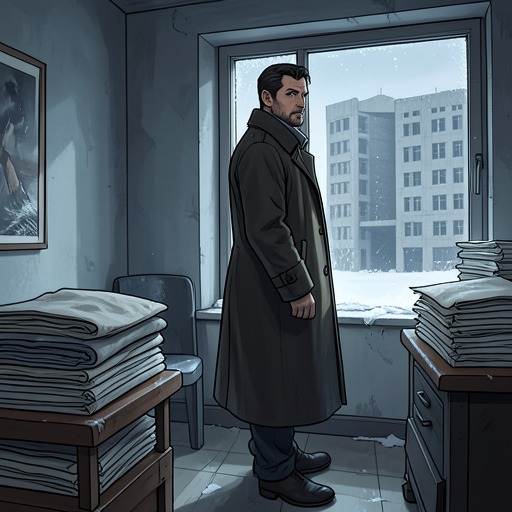
The report is kept in a black ring binder, its forty pages numbered in the lower-right corner. Smilla finds it in the archive and recognizes that its compact size makes it possible to take away in her handbag. She reads it on the floor, leaning against a flimsy wooden bookcase, in a room whose shelves have filled beyond what their builders anticipated. The contrast between the report’s neat, bounded form and the crowded archive around it gives the document a double character: it is an organized account, but also one more trace among the accumulated records of Greenland.
Smilla has entered the grounds at night and plans to leave without a trace. The report offers a momentary pause in that movement. Her curiosity leads her to read beyond the title page and the expedition’s official summary, then to return to the medical report before she puts the binder away. Its significance emerges through this act of reinspection, not from any explicit claim that the document itself makes about Isaiah.
Expedition and Fatalities
The title identifies a geological expedition by the Cryolite Corporation of Denmark to Gela Alta, carried out from July through August 1991. Its stated objective was to investigate deposits of granular ruby crystals on the Barren Glacier. The report lists five European members, including Andreas Fine Licht, a professor of Arctic ethnology. Smilla recognizes his name without at first being able to place it; the report says that the expedition was supported by the Institute for Arctic Ethnology.
The binder also contains an account, in English and Danish, of a rescue operation from Holsteinsborg to the Barren Glacier. A helicopter could not land close to the site because its engine noise might trigger an avalanche. A Cherokee 6-3000 was sent instead and landed on the water, carrying a pilot, navigator, doctor, and nurse. The rescue papers record five fatalities: one Finn and four Inuit, including Norsaq Christiansen. These details make the expedition’s human cost specific, while the report’s administrative sequence presents the disaster as something that could happen during a remote field operation.
The appendix adds mineralogical sample summaries, logs, and black-and-white aerial photographs of a glacier splitting and floating around a bright, fractured, conical cliff. A plastic folder holds about twenty letters concerning the transport of the bodies. Together, the technical records and correspondence give the report the appearance of a complete account: samples and observations, rescue documentation, medical certification, and arrangements after the deaths. That appearance of completeness shapes Smilla’s first judgment of it.
The Medical Report and Smilla’s Reassessment
After reading through the report, Smilla initially sees nothing that could explain why a boy would later fall from a rooftop in Copenhagen. The expedition appears tragic but not suspicious, and she wonders whether she has been seeing ghosts and pursuing an imagined connection. The archive’s reassuring order reinforces her uncertainty: its records preserve routine work and the everyday lives of the people who filled its offices, rather than an obvious account of wrongdoing.
Before leaving, however, Smilla opens the report again and turns to the medical section. She sees something there and concludes that the trouble of finding and reading the binder has been worthwhile. The passage does not identify the detail in a way that makes the report a self-contained explanation of Isaiah’s death; its force is that it gives her a new reason to continue. Smilla compares the feeling to the sudden care a woman may take of herself after discovering she is pregnant. The comparison marks a change in her posture: from doubting her investigation to recognizing that she must now protect herself.
Archival Record and Narrative Significance
The report’s role depends on the difference between its official surface and what Smilla can glean from it. Its sections organize the expedition as a technical undertaking, a rescue, a list of losses, and a set of post-disaster arrangements. At first that documentary order seems to make the deaths comprehensible as misfortune. The return to the medical report unsettles that conclusion without turning the binder into a complete answer. It is evidence that changes the direction of Smilla’s inquiry precisely because its apparent closure proves incomplete.
The surrounding archive also gives the object a wider significance. Smilla encounters a fragile wooden shelving system filled with records that seem to preserve an institution’s ordinary contentment, while she herself remains outside the settled working life those records represent. The report is therefore both a source about the 1991 expedition and a material link in her investigation: its documents let her move from a broad suspicion to a particular clue, even as the record’s tidy presentation threatens to make the past look settled. Its decisive consequence is not that it resolves Isaiah’s death, but that it convinces Smilla there is something worth following—and that she must take care as she does so.